The first shirt sponsors in the Football League
The history of shirt sponsors in the Football League dates from the late 1970s. In an era when English football hit hard times financially, clubs were forced – reluctantly in most cases – to look at income sources beyond the turnstiles.
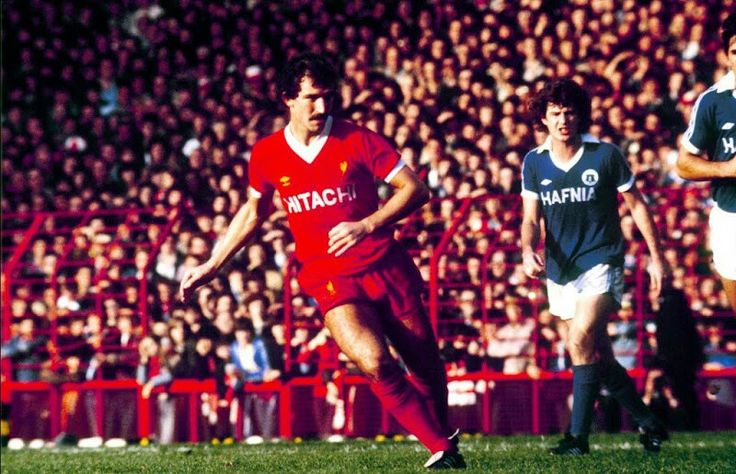
The first Merseyside derby with shirt sponsors, October 1979
In the early years of the decade, brewer Watney Mann sponsored a pre-season tournament, while Ford and Texaco also lent their name to competitions for league clubs. A 1975 Football News report described Arsenal as having recently, “after many years of postponing the decision, accepted limited advertising at the ground to increase revenue”. Despite the need for solutions to the game’s financial crisis and precedents in other countries, shirt sponsorship was not considered acceptable.
The first attempt in British football to advertise on the front of a shirt came from outside the Football League. Non-league Kettering Town carried the name of club sponsors Kettering Tyres in 1975/76 before the FA pressured them to remove it. Chief Executive Derek Dougan argued that the FA’s stance on prohibiting the sponsor’s name was hypocritical, given their lucrative deal with kit manufacturers Admiral for the national team. Fighting the ban, Dougan also pointed out that:
Had it not been for the participation of our sponsors, Kettering’s financial situation would have been grave this season. Their money has helped the club keep its head just above water. [Daily Mail, 14 Jan 1977]
Football League clubs first added sponsors to their team tracksuits rather than kit, with First Division Bristol City signing a deal with Schweppes in early 1977 – a move said to bring “full-scale sponsorship of British soccer a step nearer.” Manager Alan Dicks commented that “attitudes towards sponsorship are changing.” The FA’s executive committee were forced to discuss the issue but continued to resist shirt sponsorship. Derby County tried to team up with Saab (a Swedish car manufacturer) later in 1977, negotiating a reported three-year £300,000 deal only to be thwarted by the objection to ‘free advertising’. The BBC and ITV had made it clear that shirt sponsorship “would infringe the agreement between the football authorities and the TV organisations and could not be permitted on TV.”
With the Scottish FA already having given Highland League clubs permission to experiment with shirt sponsors, Hibernian became the first top-level UK club to carry advertising on the front of their shirt when kit manufacturer Bukta appeared from the start of the 1977/78 season. With the TV companies still refusing to televise games featuring shirt sponsorship, Hibs were forced to model an alternative kit without the Bukta name (initially in purple). By the time the FA and Football League relented, after negotiating new TV contracts, the initial shirt sponsorship deals were signed ahead of the 1979/80 season.
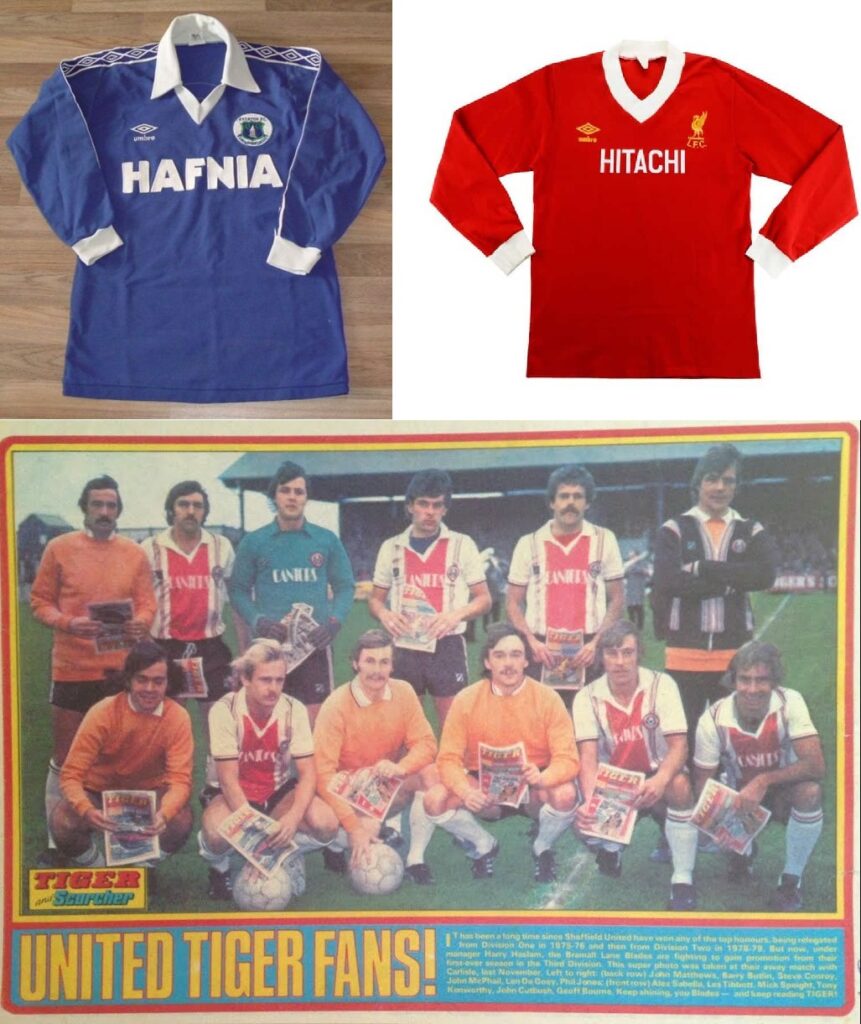
Early shirt sponsors – Everton, Liverpool, Sheffield United
League champions Liverpool agreed the first contract, with Japanese electronics firm Hitachi (also sponsoring Kevin Keegan’s Hamburg at the time) believed to be paying £50,000 a year for the three years agreed. Announcing the deal, chairman John Smith claimed, “We are talking about an industry that is desperately short of money and we are fighting for our existence.” In fact, as Liverpool’s opening game was delayed until the Tuesday, it was rivals Everton – with Hafnia, a partnership which continued to the mid-1980s – who first wore a sponsored shirt in the Football League, on Saturday 18 August 1979. It is likely that the Merseyside derby at Anfield in October 1979 was therefore the first league game in which both teams wore a sponsor’s names on their shirts.
The ruling was still that they could only be worn in non-televised games which was not the restriction it would be now, but perhaps more significantly the ban also applied to all cup competitions – given those would be the most high-profile matches. According to The Telegraph, the League’s 1980 AGM saw “lively discussion about the vexed question of shirt advertising in relation to television.” The BBC and ITV, then holding a monopoly on domestic broadcasting, were firm in refusing to show “clubs wearing advertising” – much to the frustration of the clubs.
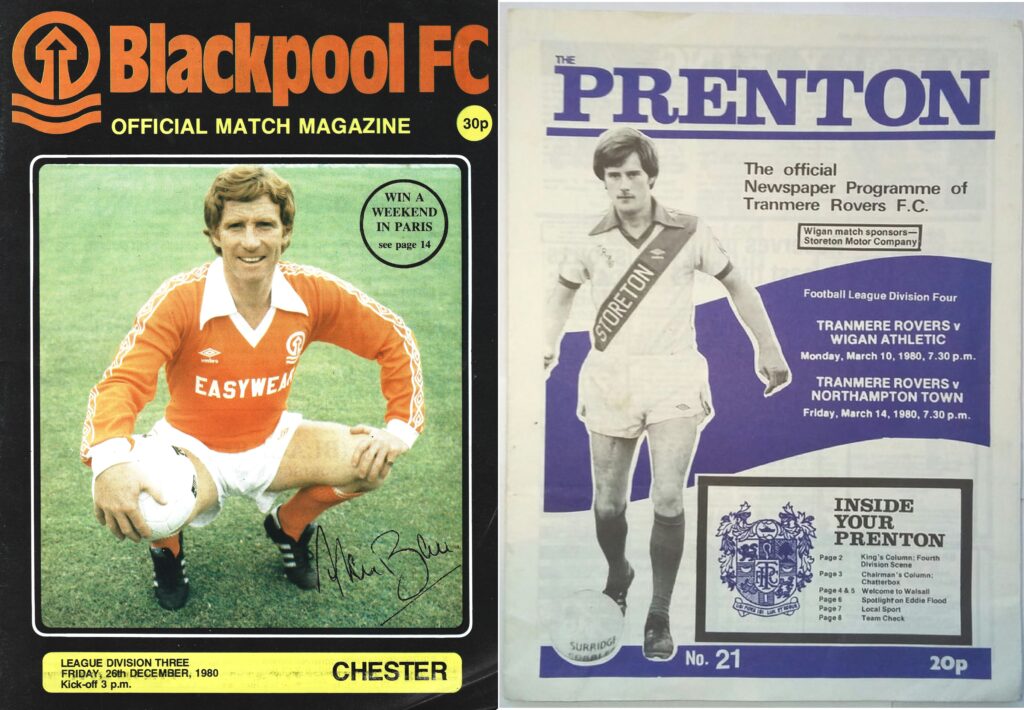
Several lower-division sides joined the big two of Merseyside in acquiring shirt sponsors for 1979/80. With television coverage less of an issue, these deals generated much-needed income, primarily from local businesses. Sponsored clubs included Blackpool (Easywear, clothing), Grimsby Town (Findus, frozen food), Sheffield United (Cantors, furniture) and Tranmere Rovers (Storeton Motors).
By the start of the following 1980/81 season, six further top-flight clubs and a number further down the league system had acquired shirt sponsors. Thwarted years earlier, Derby now advertised ‘Fly British Midland’, while Newcastle Breweries began their long-running partnership with the local football club which saw the first appearance of the iconic ‘blue star’ of their Brown Ale on the shirt.
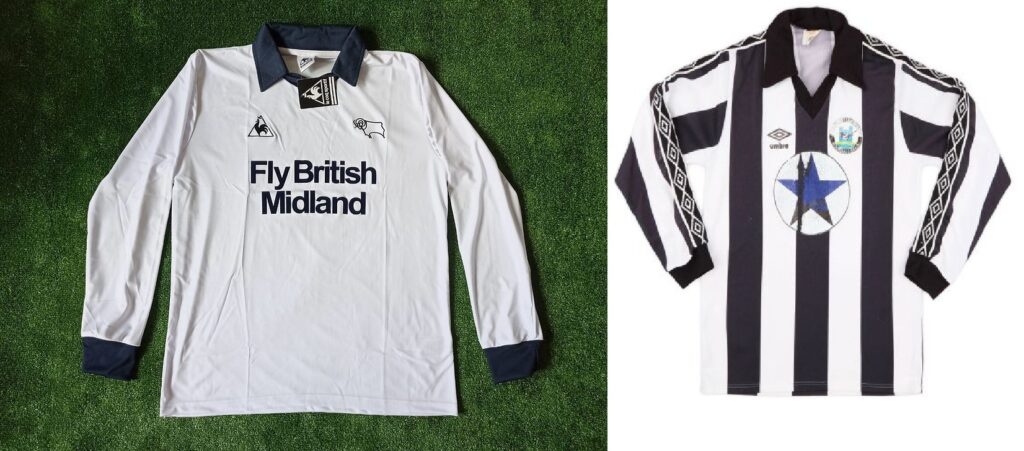
Early shirt sponsors – (above) Derby & Newcastle; (below) Nottingham Forest & Oldham
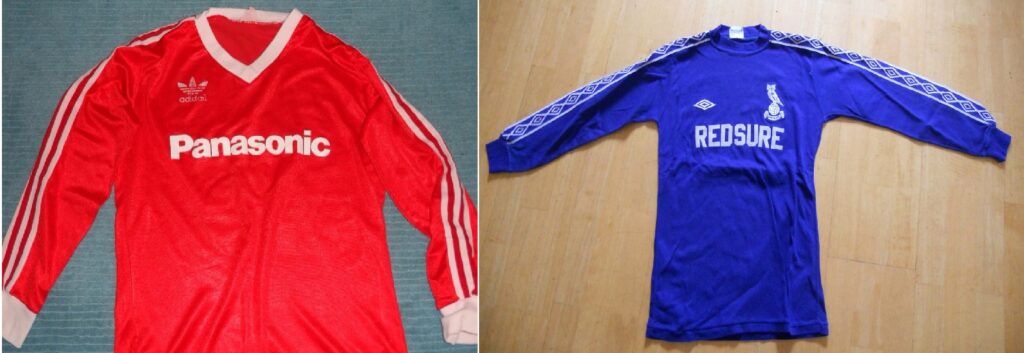
Breaches of the regulations were strictly enforced – with Nottingham Forest fined £7,000 by UEFA and then the FA for wearing sponsored shirts in cup games, as were Bolton and Newcastle (all in 1980/81). Brighton’s league game with Aston Villa was pulled from TV coverage. The Midlands club went on to win an unlikely league title that season, and by my reckoning remain the last champions not to carry a sponsor’s name on their shirt.
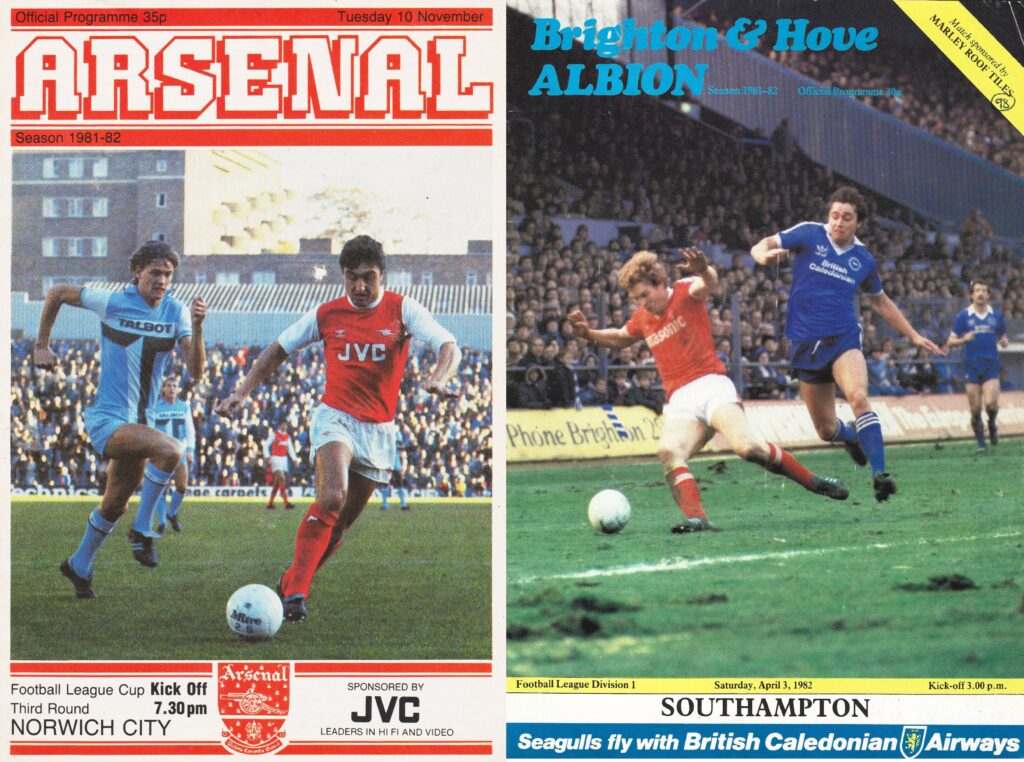
Liverpool’s link-up with Hitachi set the template for many early 80s deals at the top of the First Division. 1981/82 saw Arsenal, long regarded as the most traditional of clubs, finally embrace shirt sponsorship in what was to prove an 18-year partnership with another Japanese electronics giant, JVC. At the same time, Ipswich Town, a major force under Bobby Robson, signed with Pioneer and not to be outdone, rivals Panasonic joined up with Nottingham Forest. A more obscure electronics company, Taiwan-based Tatung, became Wolves’ first shirt sponsor the following year as they returned (briefly) to the top flight.
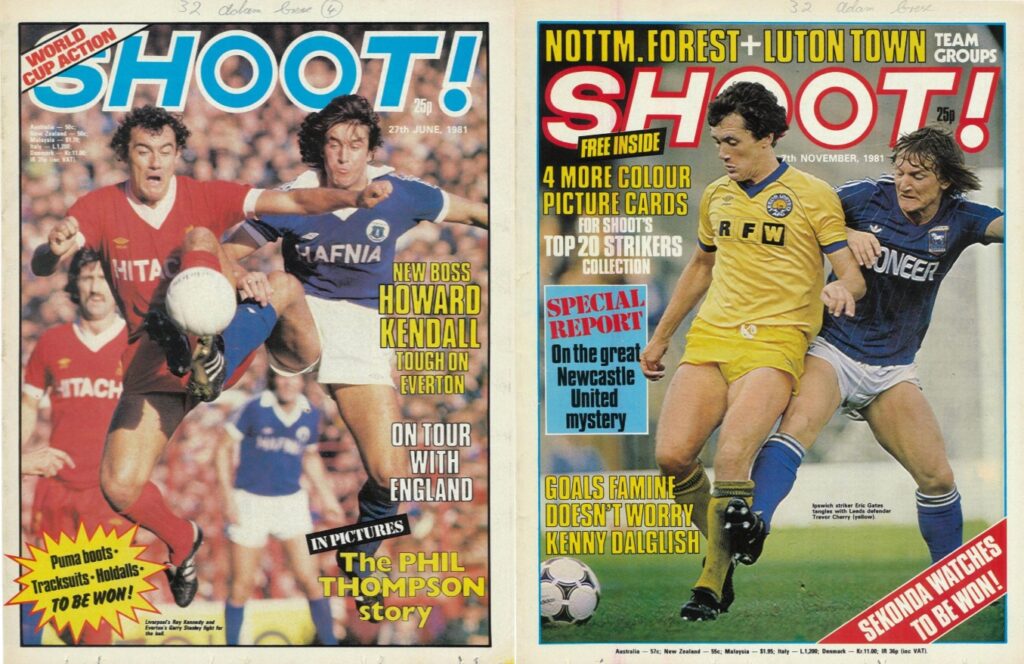
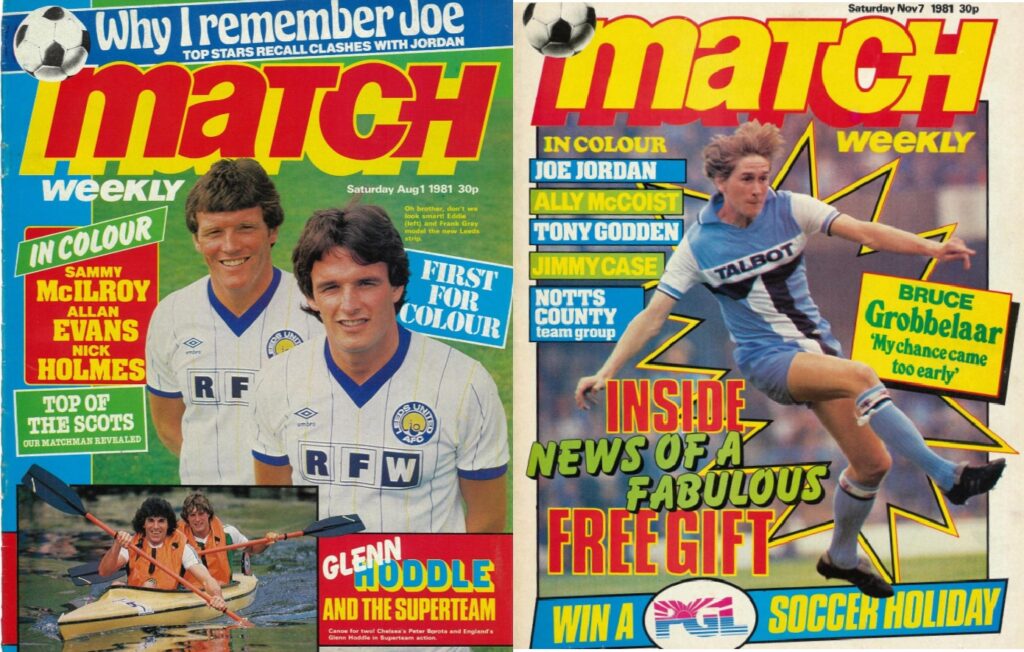
Elsewhere, clubs found sponsors closer to home and Jimmy Hill, ever the innovator, sought to maximise Coventry’s involvement with local car manufacturer Talbot. Hill was initially believed to have explored changing the club’s name to ‘Coventry Talbot’ before the company’s ‘T’ logo became part of their shirt design. Leeds went with RFW (now Winder Power), based in nearby Pudsey and continued to be associated with local businesses up until winning the last pre-Premier League First Division title in 1991/92 with the regional newspaper, Yorkshire Evening Post, on their shirts.
Meanwhile in the early 1980s a major competition accepted sponsorship for the first time when the Milk Marketing Board, an arm of the National Dairy Council, paid £2m for the League Cup to be known as the ‘Milk Cup’ for five seasons (1981-86) – it has carried a sponsor’s title ever since. Even more revolutionary was the Football League itself adding the name of Japanese multinational Canon for three years from 1983, who paid £3.3m for the privilege.
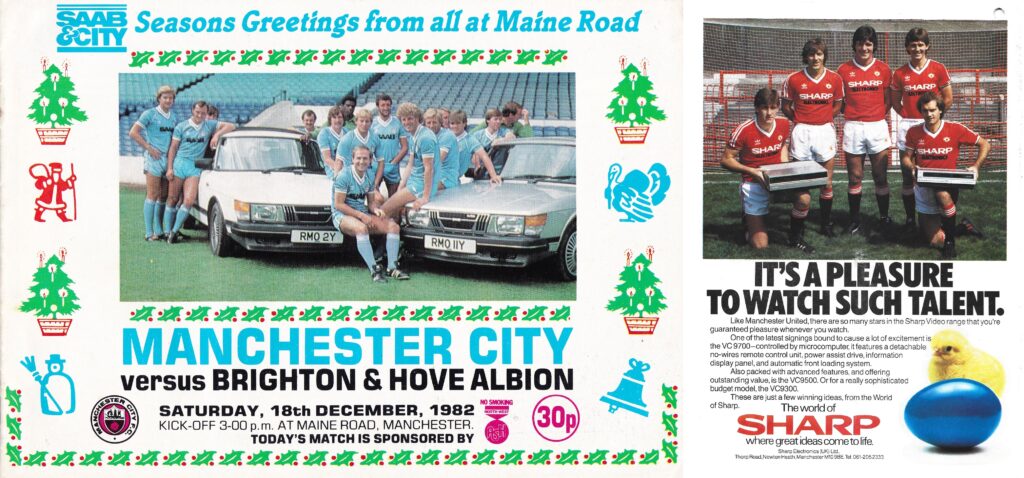
Saab finally secured shirt sponsorship in 1982/83, with Manchester City, when neighbours Manchester United’s long association with Sharp Electronics began. The two-year £500,000 deal with yet another Japanese electronics firm was English football’s most lucrative club tie-in at that date. Liverpool changed their sponsor to Crown Paints after the expiry of the Hitachi deal, while Forest and West Brom were also on their second sponsor. As well as electronics giants, vehicle manufacturers advertised with rivals Luton Town (Bedford Trucks, who had replaced Tricentrol) and Watford (Iveco) while Coventry remained with Talbot.
In April 1983, The Telegraph reported that the League and television were facing a ‘Catch-22’ situation over match coverage – “The main stumbling block is shirt advertising.” While the clubs looked to generate extra revenue, television companies remained “adamant that shirt advertising will not be negotiated”. The impasse continued for the rest of that season.
The ban on shirt sponsors for televised matches and cup games was finally relaxed ahead of the 1983/84 season, in which the first cup finals with sponsors were played. However the league insisted on a stipulation that for televised games, sponsors’ “Shirt advertising be permitted up to 216 square inches, but no lettering to exceed two inches in height” – half the size allowed for league games. During the following season Aston Villa were called before the League Management Committee for breaching the limit with their first shirt sponsor, local brewery Davenports.
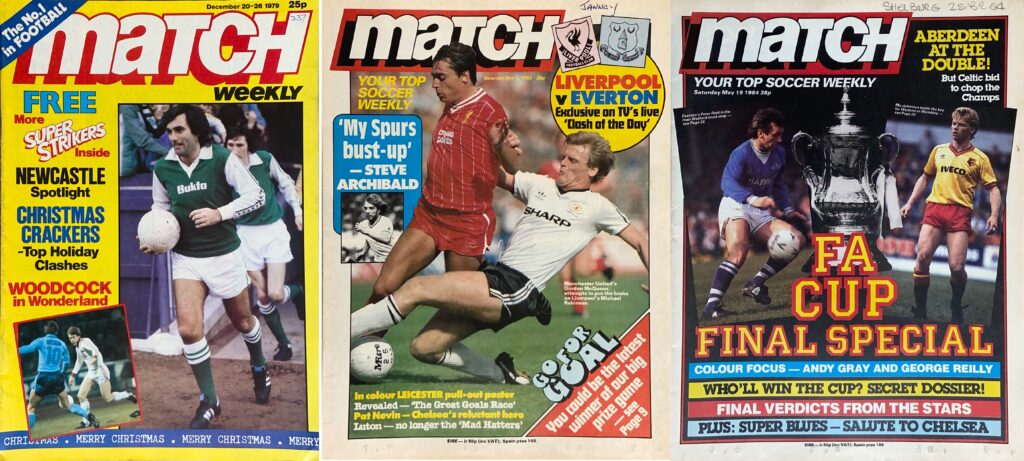
1983/84 also saw all of the 22 First Division clubs wearing sponsored shirts. As John Devlin wrote on his True Colours site: “The big news though of course was that this was the first ever season that every top flight side had a shirt sponsor. The fact that this was the same season that the TV companies relaxed their ban on sponsored shirts was no coincidence, now companies were able to gain the full benefit of paying to see their brand on team kit.” 1984’s FA Cup Final between Everton and Watford was therefore the first one broadcast with teams carrying shirt sponsors.
Another of the ‘big’ clubs signed their first shirt sponsorship deal this season as Spurs joined forces with the German brewery Holsten for a long-running partnership until 1995. It had been reported earlier in the decade that modernising chairman Irving Scholar had been holding out for a £1m deal, which accounts for sponsorship arriving relatively late. Unfortunately the 1987 FA Cup Final saw a kit mix-up which resulted in half the Spurs team wearing shirts without the sponsors’ logo.
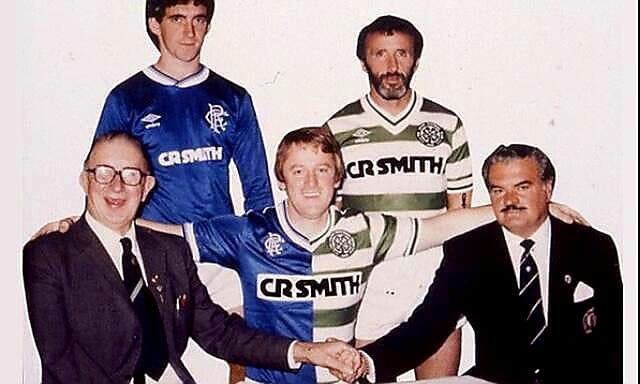
Shirt sponsorship in Scotland lagged slightly behind England after Hibernian’s pioneering Bukta deal, but in 1984 both Celtic and Rangers took the plunge for the first time – with the same sponsor. Double-glazing company CR Smith, not wanting to alienate either side of the Old Firm divide, appeared on the shirts of both clubs over the following seasons. The pair have since shared several further sponsors.
By the mid-80s it was unusual for any top-flight team to be lacking shirt sponsors, but West Brom carried a distinctive ‘no smoking’ logo for two seasons after teaming up with the West Midlands Health Authority. In 1986 Everton, between winning two league titles, switched sponsor from Hafnia to yet another electronics conglomerate, NEC (Nippon Electronics Corporation), whose name remained in place until 1995 – that year’s FA Cup win being the club’s last trophy to date.
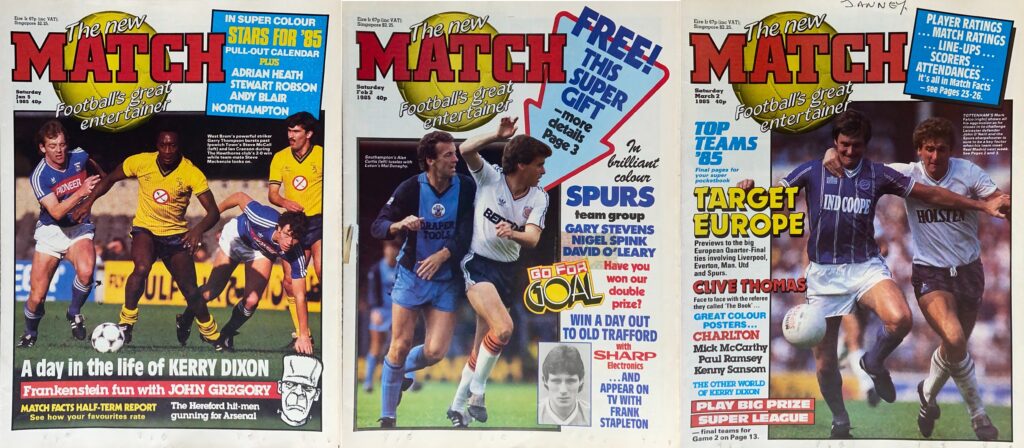
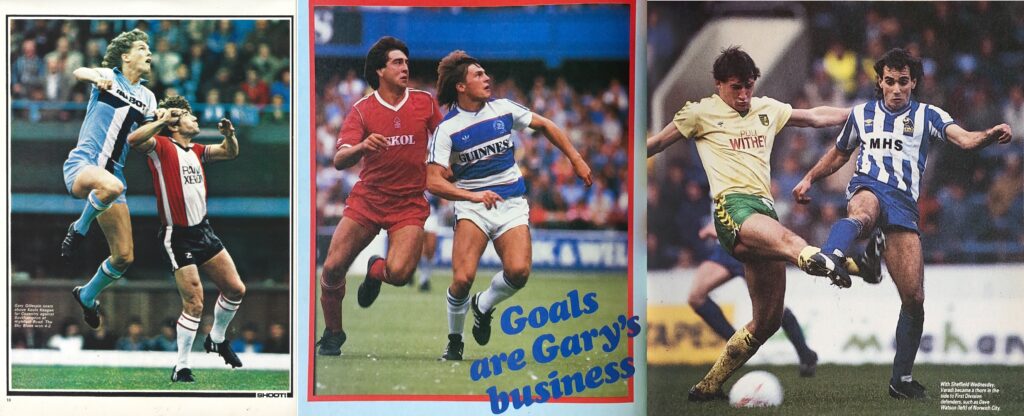
As the decade progressed, alcohol advertising – both local and global – became prominent on club’s shirts across the divisions (Ansells, Bass, Courage, Foster’s, Greenall’s, Guinness, Ind Coope, Lees, McEwan’s, Marston’s, Newcastle Brown Ale, Shipstones, Skol, Tuborg, Vaux, Whitbread, William Younger). Danish company Carlsberg forged a long-term partnership with Liverpool in the Premier League era, but had first been associated with Northampton Town (where they have a brewery) – marked with a ‘C’ – and later appeared on Wimbledon’s shirts as they won the FA Cup in 1988.
The sponsors worn in these early days often remain strongly associated with a club, for example Wang (Computers), appeared on Oxford United’s shirts for their debut First Division season in 1985/86, which also saw Wembley glory as they lifted the League Cup. Coventry’s famous 1987 FA Cup win saw them wearing Granada Bingo shirts – a sign of different times.
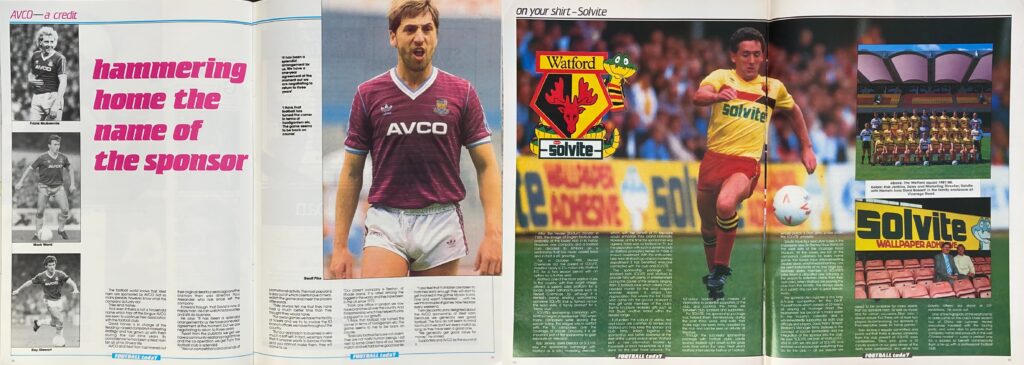
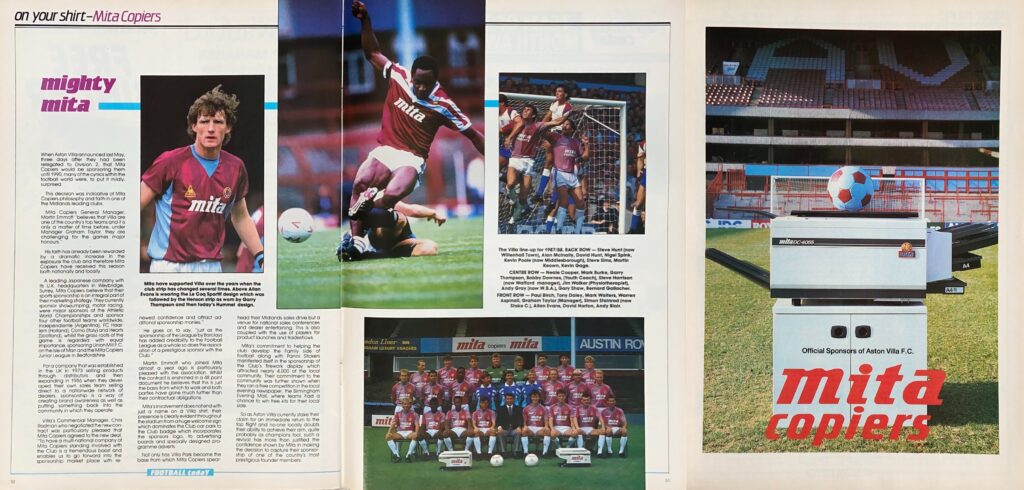
Club programmes naturally gave plenty of exposure to the various sponsors, and while the established football magazines Match and Shoot! generally shied away from commercial matters, from 1987 newcomer Football Today included a regular section on club sponsors. The Football League’s much-maligned centenary celebrations during 1987-88 were sponsored by Mercantile Credit, who were promoted in programmes and publicity for the various events. For the showpiece Wembley fixture, their name appeared on the League’s shirts as they took on a Rest of the World XI. By then, shirt sponsorship was the norm across all league divisions, and it became a rarity for any club to be without it.
Amazingly, at the start of the Premier League – a competition brought about to increase commercial revenue – Oldham Athletic and Wimbledon (two of its least fashionable members) began the 1992/93 season without shirt sponsors!
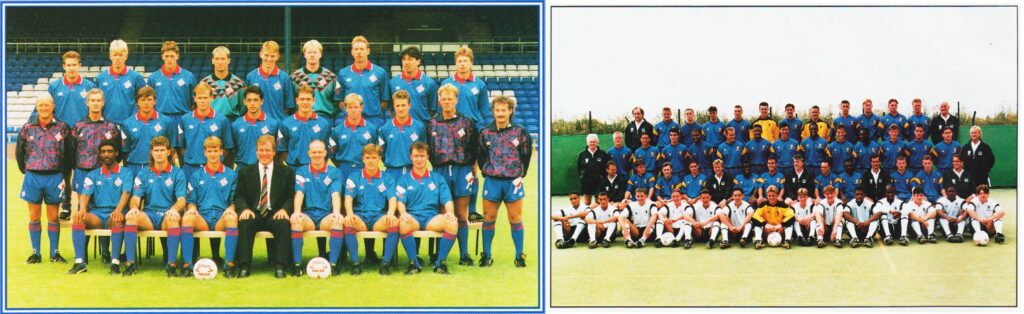
Several images courtesy of Miles McClagan (Flickr & X @TheSkyStrikers).
The Football League’s finances and sponsorship are among the topics discussed in my book Before the Premier League: A History of the Football League’s Last Decades.
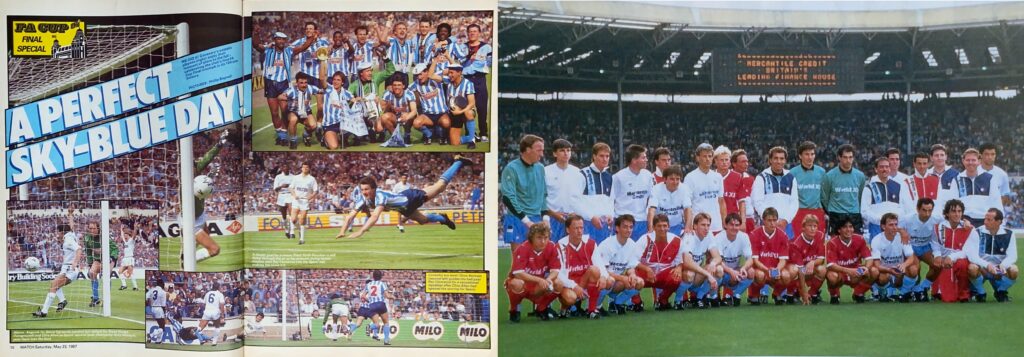
1987’s FA Cup Final & Mercantile Credit Centenary Classic