1986 World Cup: Background & Preparations
The 1986 World Cup returned to Mexico 16 years after it hosted Brazil’s historic triumph and Pelé’s international swansong. Initially awarded to Colombia at FIFA’s 1974 congress, by the early 1980s it was clear that a struggling economy would struggle to cope with the 24-nation extravaganza and they officially withdrew at the end of 1982. Competing against rival bids from the US and Canada, in May 1983 FIFA then confirmed the 1986 finals would be held in Mexico – becoming the first country to host the World Cup twice after the spectacle of 1970 (soon to be followed by Italy, the next time around).
Despite suffering a devastating earthquake in September 1985, with catastrophic loss of life and billions of pounds’ worth of damage caused in Mexico City, they remained the hosts. The massive Azteca Stadium was amazingly unscathed, and work continued on building and refurbishing new and existing stadia across the country. With the nation already in debt, the Mexican government was happy for the television company Televisa to bear the financial burden of the tournament and its construction costs. Handily, Guillermo Cañedo happened to be a vice-president of both FIFA and Televisa.
As well as the Azteca, 1970’s venues in Guadalajara, León, Puebla and Toluca were all used again in 1986 alongside seven other stadia, with 11 different cities represented in total.
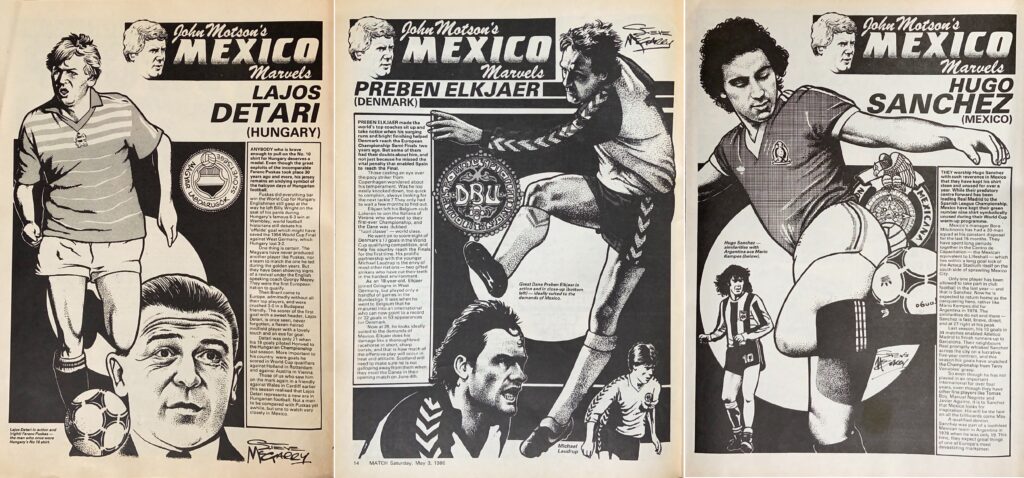
The host’s hopes rested on their fanatical home support and manager Velibor ‘Bora’ Milutinović’s ability to get the most out of a squad short on star names other than Real Madrid striker Hugo Sánchez. Milutinović was embarking on the first of five successive World Cups in which he took charge of different nations.
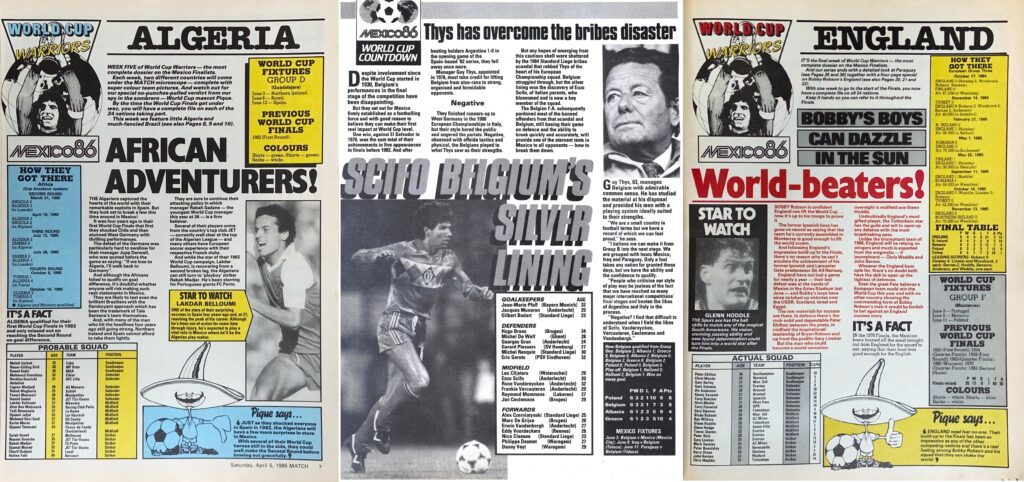
Telê Santana returned to take the reins for Brazil, raising hopes of a repeat of 1982’s mesmerising performances – and with a stronger back five and the finisher they had lacked in Spain, Careca, replacing the hapless Serginho. However, the flamboyant Éder was banished from the squad, to be followed by right-back Leandro (an unknown, Josimar, took his place). Of the magical midfield, Cerezo was missing and Falcão, Sócrates and Zico were all, like left-back Júnior, in their thirties and approaching the twilight of their careers.
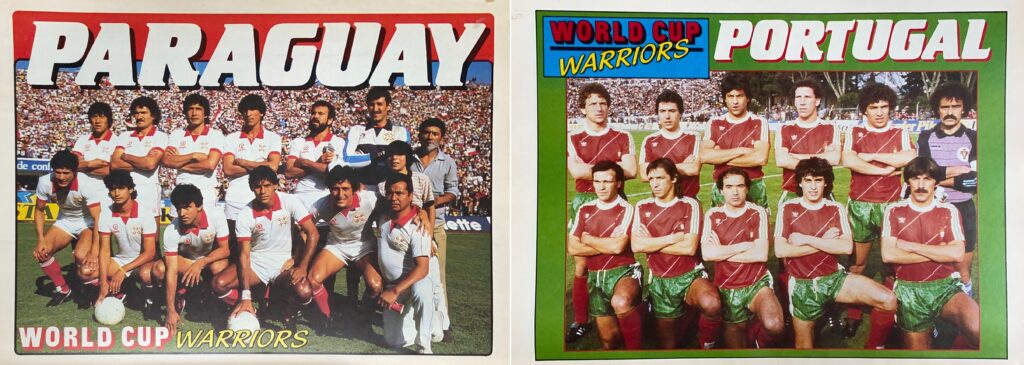
Paraguay were the surprise 1986 World Cup CONMEBOL qualifiers, having last reached the finals in 1958. They had 1985’s South American Footballer of the Year in Julio César ‘Romerito’ Romero, who succeeded Uruguay’s Enzo Francescoli. The Uruguayans returned after a 12-year gap with Francescoli carrying the attacking hopes of the 1983 Copa América winners, in front of a defence with a reputation for ruggedness…
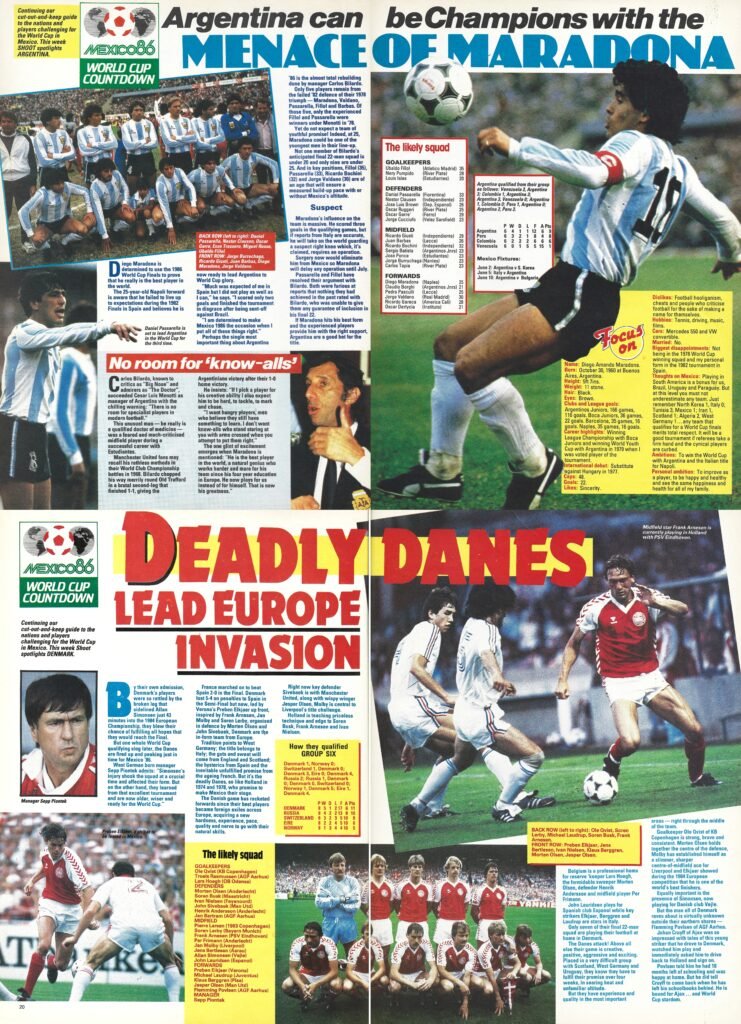
Argentina had needed a late goal to qualify but boasted the world’s best player in Diego Maradona, now established in Serie A with Napoli after an unhappy time at Barcelona. Last seen at a World Cup being sent off in disgrace against Brazil four years earlier, he carried Argentina’s hopes almost single-handedly. Under Carlos Bilardo, a more pragmatic coach than 1978’s World Cup winner César Luis Menotti, they were to meet holders Italy at the group stage. Though Enzo Bearzot was still at the helm of a squad containing many of 1982’s champions, the Italians were by now a fading force having failed dismally to qualify for the Euro 84 finals.
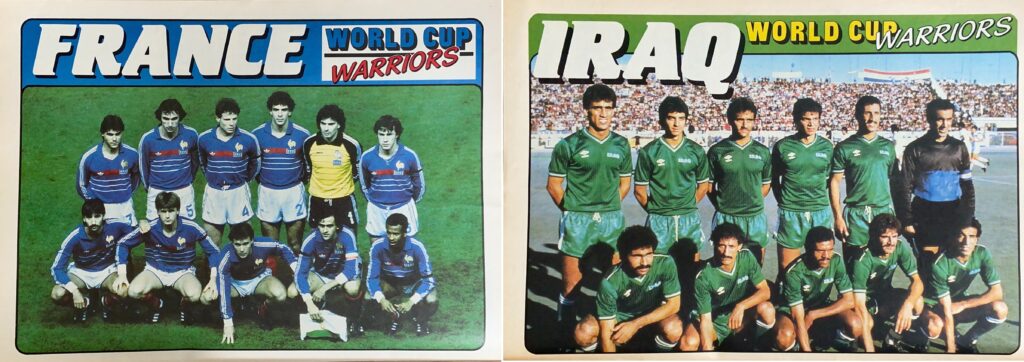
The USSR too had missed out on the Euros but with the experienced Valeriy Lobanovskyi back in charge only weeks before the tournament, included 12 players from Dynamo Kyiv in their squad, recently triumphant in the European Cup Winners’ Cup – under Lobanovskyi. They were alongside reigning European champions France and newcomers Canada, who took the single CONCACAF qualifying place available with Mexico hosting. The French were naturally seen as Europe’s strongest challengers, spearheaded by Juventus’ triple Ballon d’Or winner Michel Platini, though he and fellow members of the ‘magic midfield’, Alain Giresse and Jean Tigana, were all the wrong side of 30. That group was rounded out by Hungary, seen in some quarters as outside contenders after a 3-0 friendly win over Brazil in March (though that was in Budapest), ahead of their ninth World Cup appearance – and last to date.
Denmark had emerged as a force in the 1984 Euros and were one of the strongest European outfits with their exciting strikers Preben Elkjær – top scorer in European qualification – and Michael Laudrup. Belgium edged out neighbours the Netherlands with a late away goal in their play-off, continuing the Dutch’s dismal major finals record of the 80s (which was to change dramatically two years later).
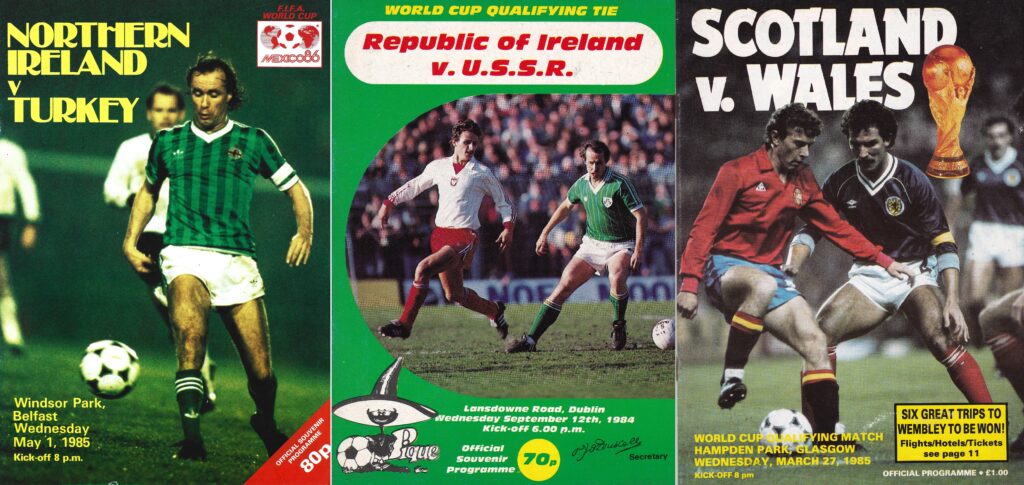
Four of the home nations had been in the same qualifying groups; Scotland and Wales went to the final game, the Scots prevailing with a draw in Cardiff on a night which saw the tragic death of their manager Jock Stein. After beating Australia in the inter-continental play-off, their reward under caretaker Alex Ferguson was to be placed in the ‘group of death’ with the Danes, West Germany and Uruguay. England and Northern Ireland both qualified from the same group, the Northern Irish with a crucial win in Romania and Pat Jennings-inspired goalless draw at Wembley. The Republic of Ireland, in their final qualifying campaign under Eoin Hand, disappointed with a fourth-place group finish – the Jack Charlton era was soon to begin.
England went into the 1986 World Cup with captain Bryan Robson an injury worry after dislocating his shoulder at West Ham in February, and suffering a recurrence in a pre-tournament friendly with Mexico in Los Angeles. Then the First Division’s top scorer Gary Lineker hurt his wrist in their last warm-up game against Canada, leading to fears he might miss the tournament – he was passed fit to play in a cast.
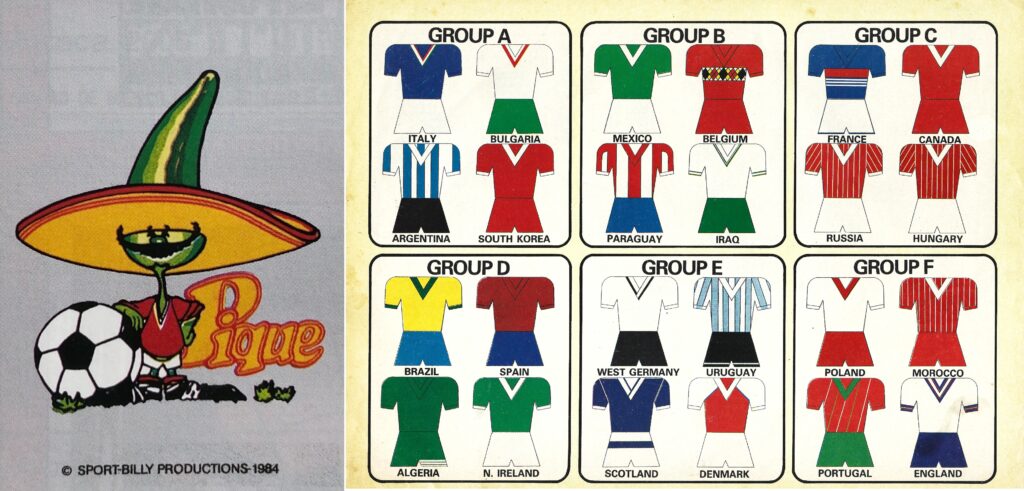
Making a finals debut alongside Denmark were Iraq and Canada, while South Korea returned for the first time since a mauling in 1954. Morocco were back in Mexico having only previously competed in 1970. They joined the returning 1982 surprise package Algeria as Africa’s representatives, and were drawn for a first-ever meeting with England. In the same group, Portugal were ready for a first taste of the finals since 1966 and Eusébio’s heroics, with Poland – third-place in 1982 – rounding out another competitive-looking group. Morocco and Iraq both employed Brazilian coaches, in José Faria and Evaristo de Macedo respectively. West Germany’s Franz Beckenbauer was hoping to emulate Mário Zagallo in 1970 by winning the World Cup as a player and then manager (he would have to wait a little longer).
After the unsatisfying second-round group stage that had been used in the previous three tournaments, a knockout stage of 16 teams was introduced for the 1986 World Cup. As there were still 24 nations involved, this meant an awkward process of four third-placed qualifiers from the six groups and only eight countries actually being eliminated from the first round. After 1982’s ‘Disgrace of Gijon’ when West Germany and Austria produced a ‘convenient’ result for both nations to progress at Algeria’s expense, the final group games were to kick off simultaneously in 1986 (and ever since). There were to be 52 matches, played on 23 of the tournament’s 30 days.
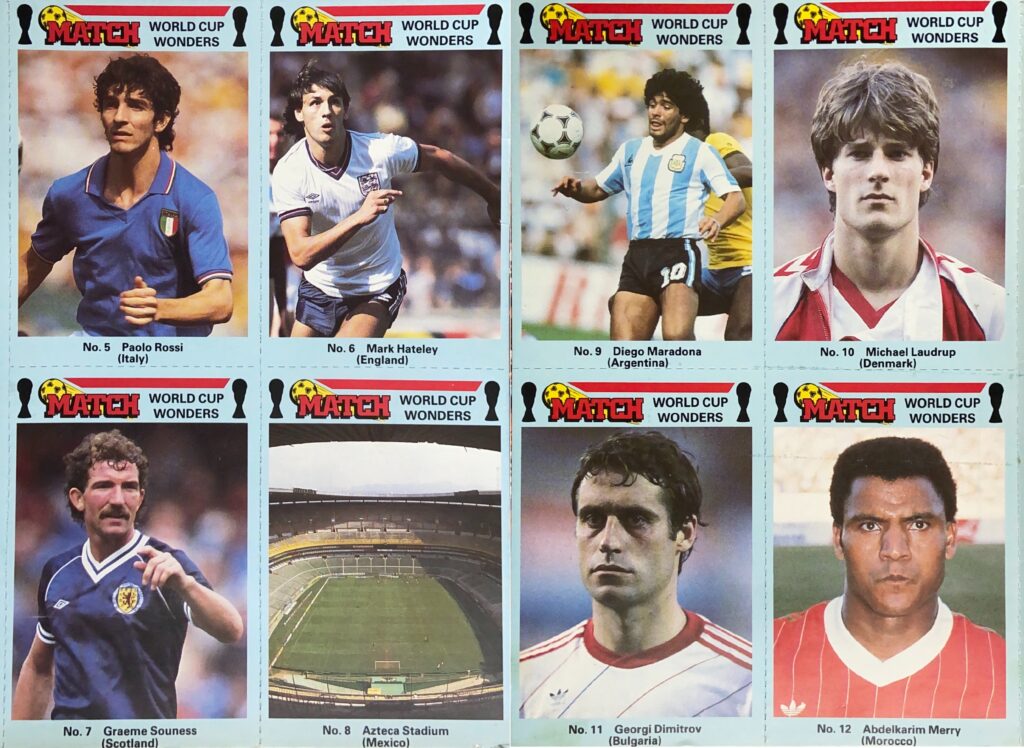
There was also the matter of playing at altitude and midday kick-off times to suit a European television audience, both of which had taken their toll in 1970 and posed the same problems again. Local times of 12 and 4 pm translated to 7 and 11 pm (past my bedtime!) for UK viewers, with temperatures estimated at between 85 to 100°C. England were to be based in the heat of Monterrey for their group-stage fixtures, while the high altitudes of Guadalajara, Mexico City and Toluca promised draining conditions, just as they had 16 years earlier.
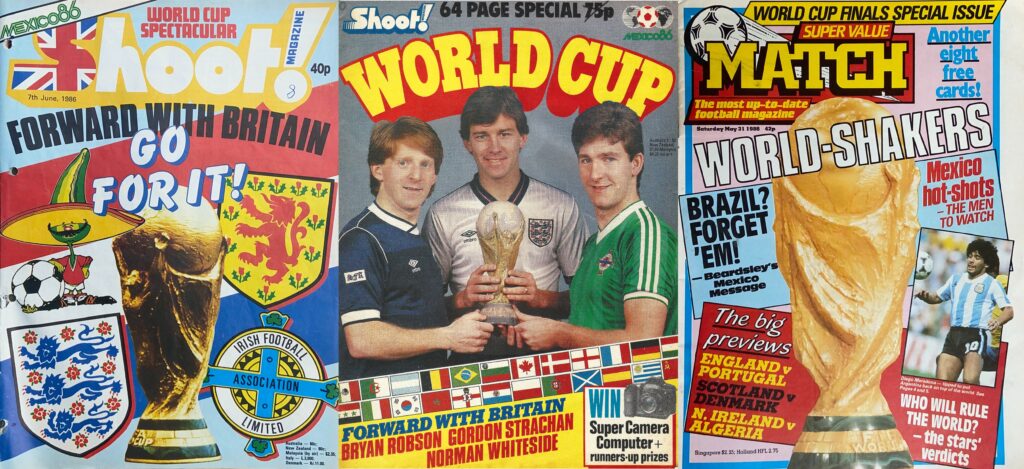
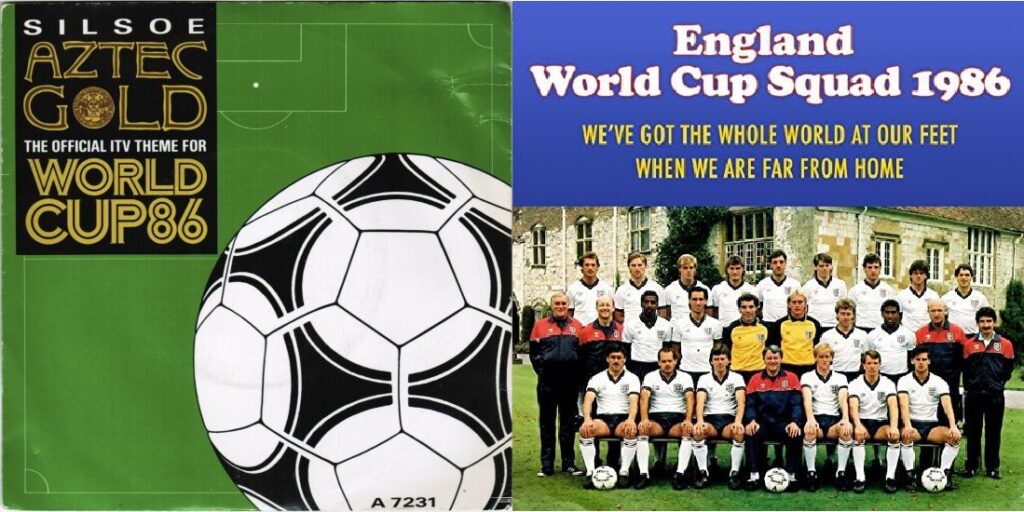
As in 1982, in a convention of the time, each of the home nation’s squads made a World Cup record. England followed ‘This Time’ with the less than memorable ‘We’ve Got the Whole World at Our Feet’ (included on an accompanying album) – hard to believe we were only four years away from ‘World in Motion’. Scotland’s ‘Big Trip to Mexico’, like England’s effort, failed to stay in the memory or impress the record-buying public. Completing the trio, ‘Come on Northern Ireland’ suffered much the same fate. The most successful tune turned out to be ‘Aztec Gold’, ITV’s theme song, written by Rod Argent of the Zombies and performed under the name Silsoe.
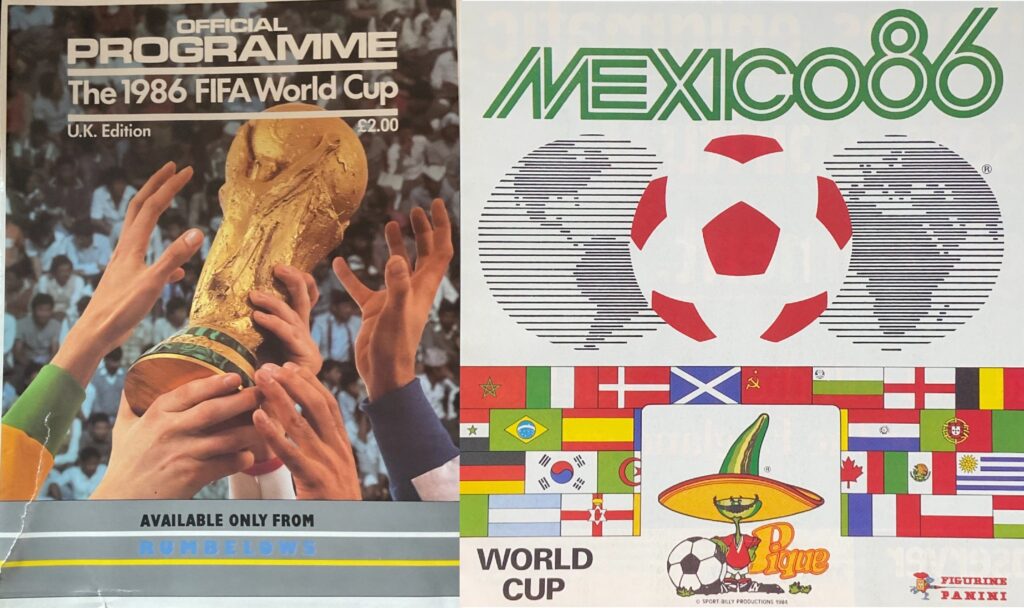
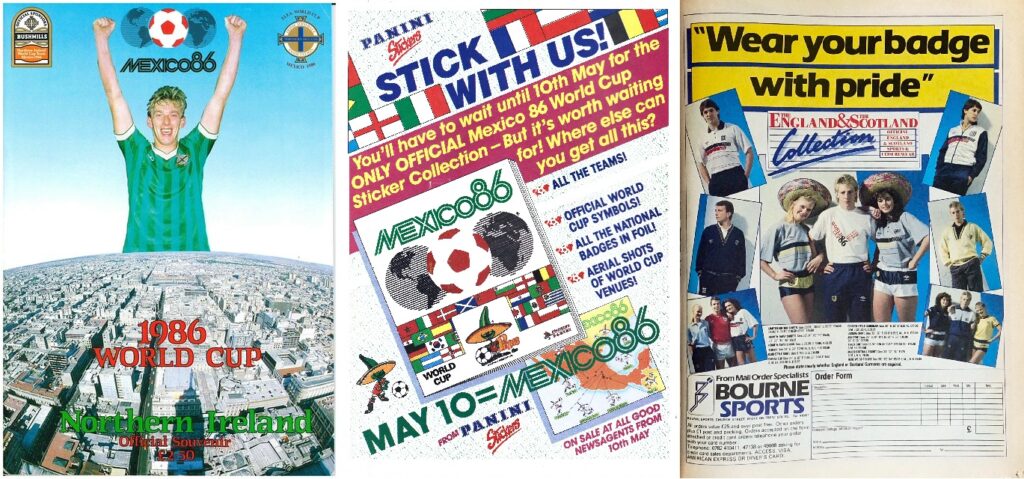
The moustachioed, sombrero-wearing mascot Pique (described as “a cheerful jalapeño pepper”) seemed to play into every Mexican national stereotype, but appeared on all the tournament’s promotional material. This included the highly successful Panini 86 World Cup sticker album, then at the height of its popularity – at least on the evidence of the frenzied swapping on my school playground.
Several images courtesy of Miles McClagan (Flickr & X @TheSkyStrikers).