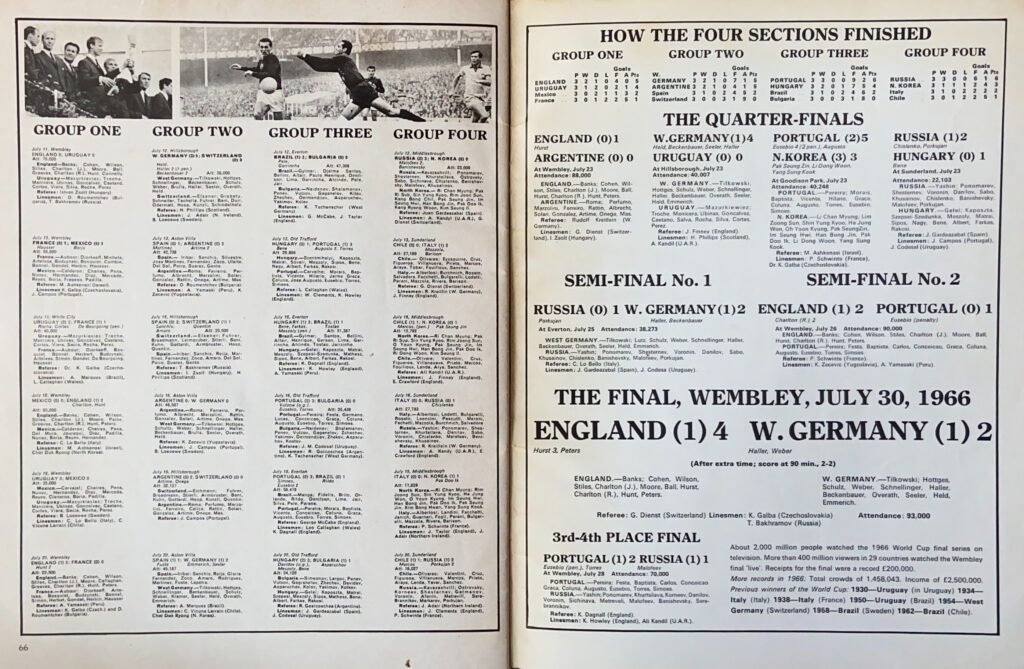
1966 World Cup: The Finals
After a prolonged build-up to the eighth World Cup, the 1966 finals kicked off on 11 July – later than any edition since the very first in 1930. With Sunday football prohibited, England’s opening Wembley stalemate with Uruguay took place on a Monday evening (followed by tedious goalless draws in the next three World Cup openers). Both sides’ cautious and at times cynical approach set the pattern which largely defined these finals.
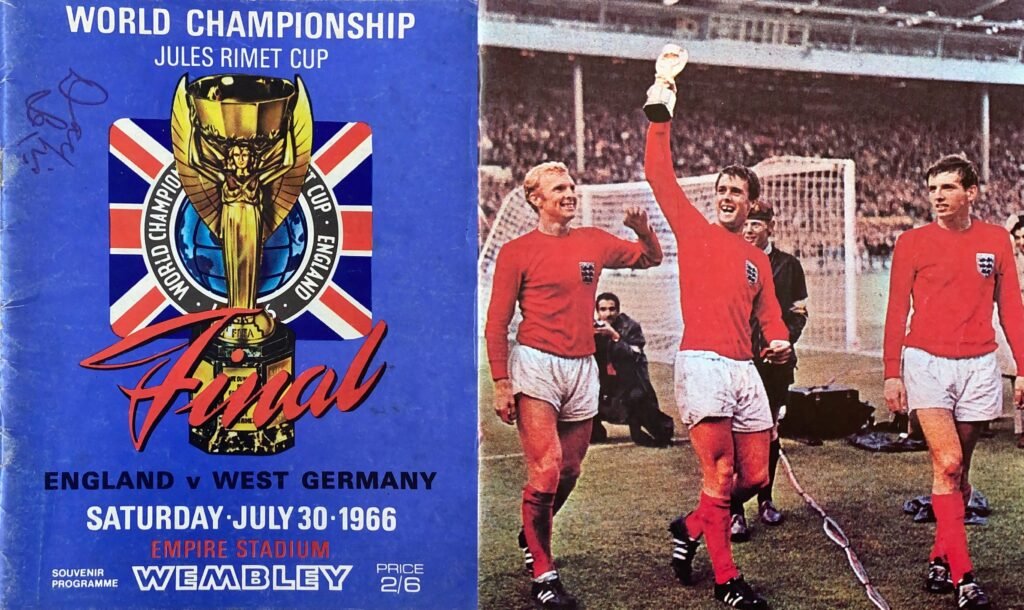
A 16-team tournament allowed the simplest of formats – four groups of four, from which the top two in each progressed to the quarter-finals. No third-place qualifiers or second group stages. It had been used in previous editions and was retained for Mexico 1970, before the tinkering started in 1974 and expansion followed in 1982.
The England squad followed their lacklustre opening game with a visit to Pinewood Studios the following day, 12 July – where Sean Connery was filming You Only Live Twice. Alf Ramsey and his players also met and mingled with Yul Brynner, Robert Morley, Cliff Richard, Viviane Ventura – reportedly the team’s official mascot – and Norman Wisdom.
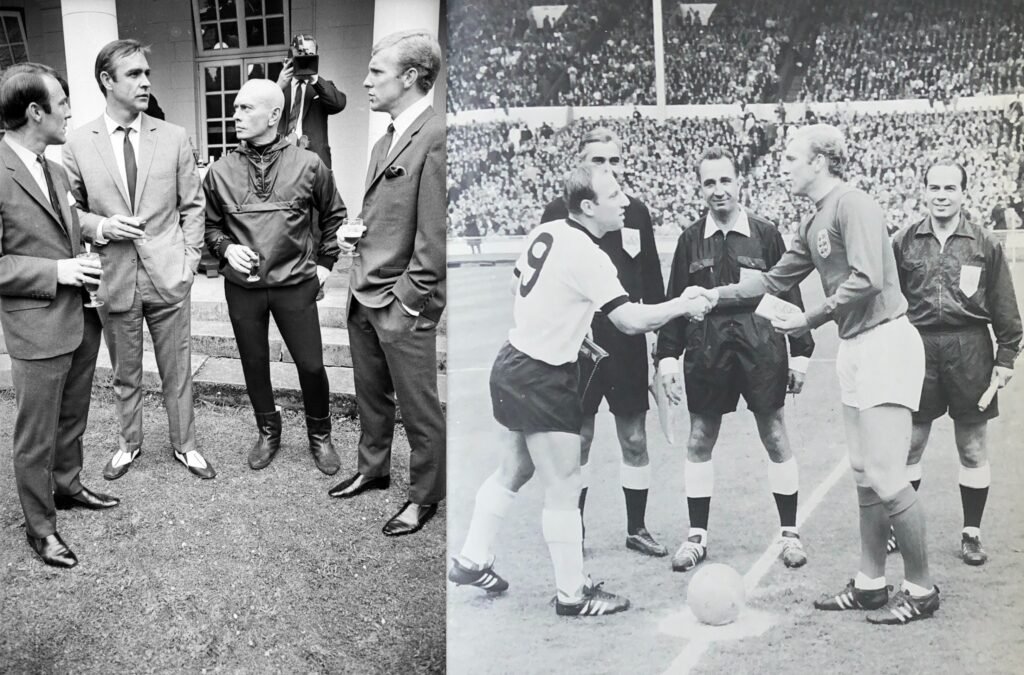
Jimmy Greaves & Bobby Moore meet Sean Connery & Yul Brynner; Uwe Seeler & Bobby Moore, World Cup Final captains
England were based throughout at Grade II-listed Hendon Hall Hotel, only five miles from Wembley and within easy reach of their training facilities at Roehampton, where they ate from the same menu as other guests and public access was relaxed. Accompanying the squad was a notably small group consisting of Ramsey and his two formal staff members, physio Les Cocker and assistant Harold Shepherdson, who both operated as trainers, supplemented by Dr Neil Phillips. The medical staff were expected to help in their own time and the senior side’s usual doctor, Alan Bass, had run out of holiday leave though he later rejoined the squad and sat alongside Ramsey on the bench for the final.
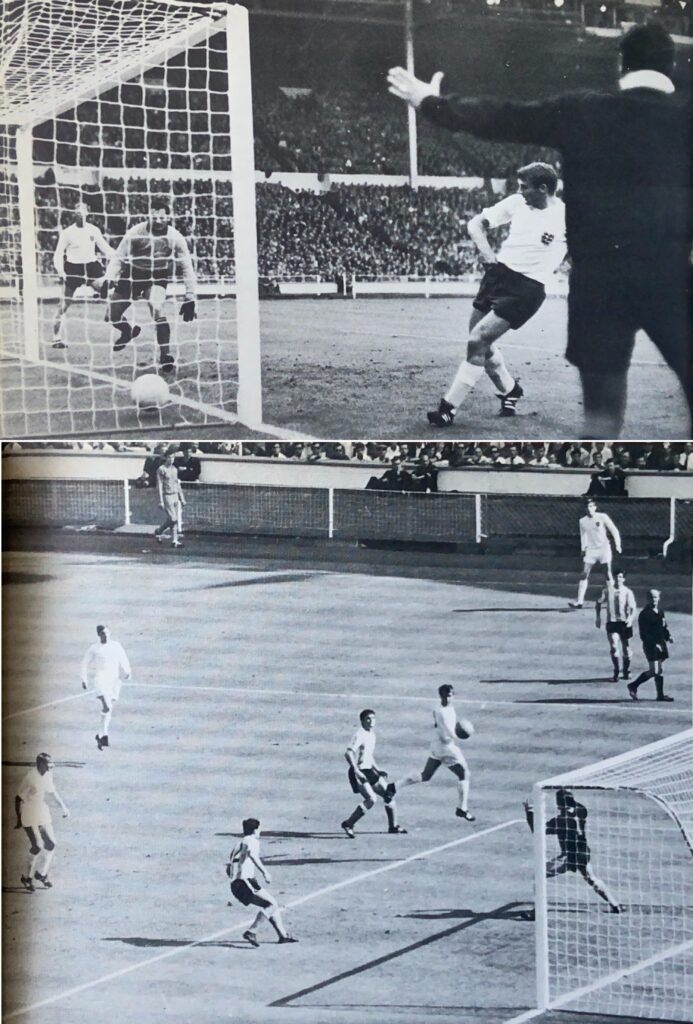
England 1966 World Cup goals from Roger Hunt v France (above) and Geoff Hurst v Argentina (below)
Group 1 was predictably dominated by England, who topped the table without conceding a goal. They were joined by unbeaten Uruguay while France and Mexico departed a low-scoring group. Uruguay’s win over France took place at the unusual venue of White City Stadium – rather than cancel the established Friday night greyhound racing at Wembley, the fixture was moved! Group 2 saw West Germany and Argentina, not then the giants of the international game they would become in the next decade, both progress unbeaten at the expense of Spain and Switzerland.
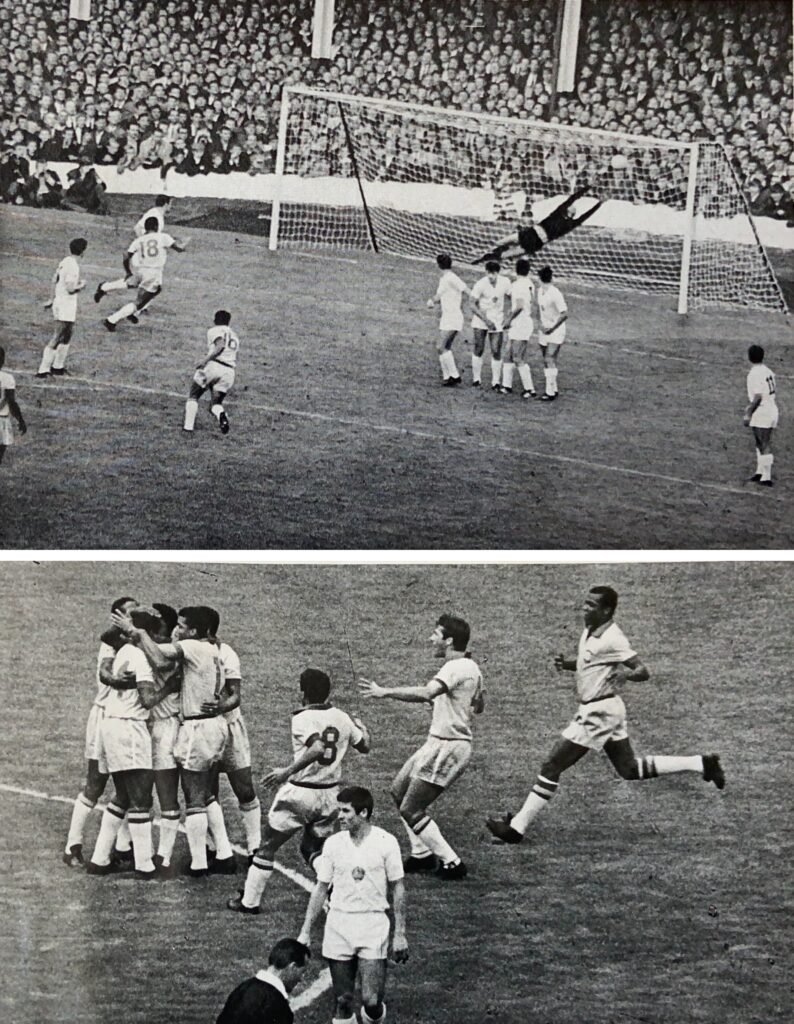
More excitement was to be found in Group 3, where Goodison Park saw Brazil, aiming for a third consecutive title, beaten by both Hungary and Portugal. The saddest sight of the 1966 finals was surely Pelé being carried from the pitch in the latter game – later returning, but a passenger – though fortunately he later reversed his decision to never play in another World Cup. Bulgaria, who lost every game, would have to wait until 1994 for their first finals win.
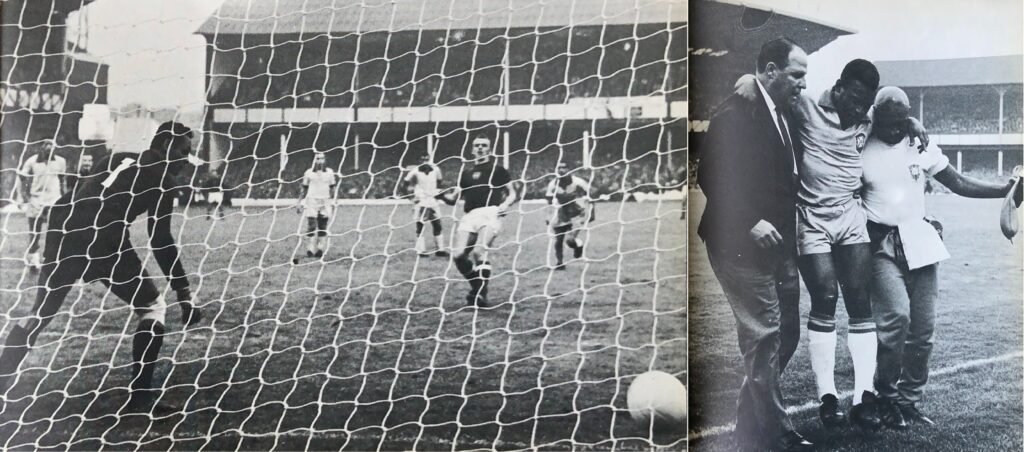
Hungary’s Kálmán Mészöly seals their win against Brazil; Pelé is carried from the field v Portugal
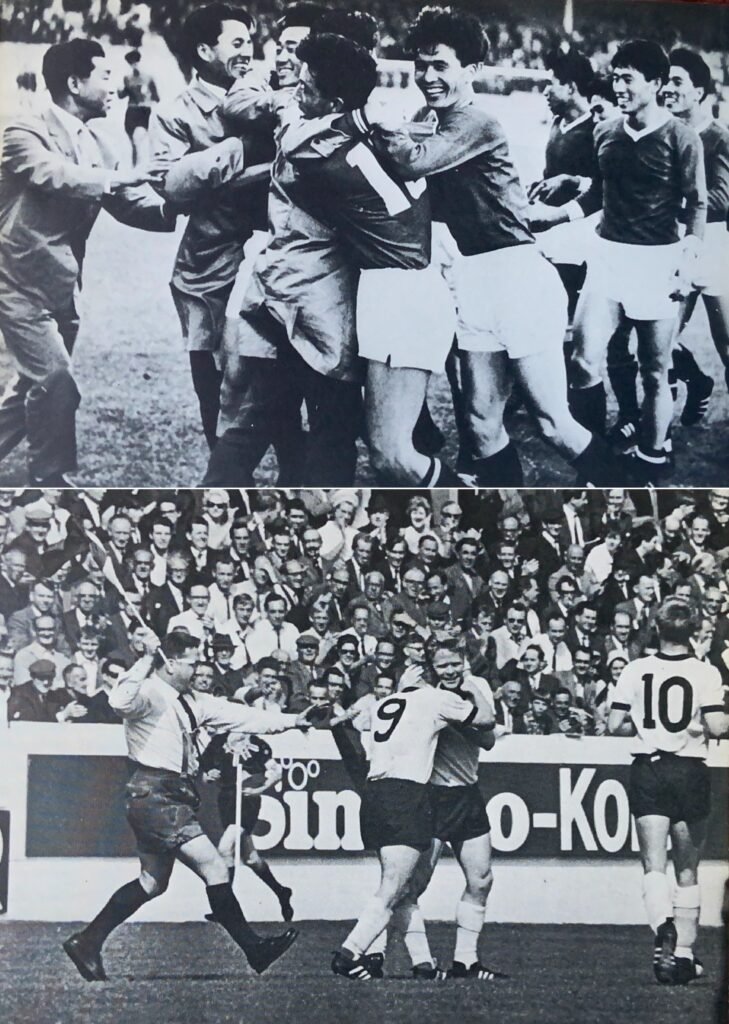
The USSR cruised through Group 4, matching Portugal with three wins, led by their legendary goalkeeper Lev Yashin. The result of the tournament was arguably North Korea’s upset of Italy at Middlesbrough’s Ayresome Park, which set a new bar for World Cup shocks and led to an uncomfortable reception of rotten tomatoes for the Italian squad on their return home. The North Koreans’ previous meeting with Chile at the same venue was watched by 1966’s lowest crowd of 13,792.
Controversy followed in the quarter-finals (all played simultaneously at 3pm on Saturday, 23 July), with both remaining South American nations complaining bitterly about sendings-off by European referees. England’s bad-tempered 1-0 victory over Argentina is mainly remembered for the first-half dismissal of Antonio Rattín by West German referee Rudolf Kreitlein and his subsequent refusal to leave the pitch. The incident led to the English official Ken Aston developing the yellow and red cards which were issued at Mexico in 1970 and onwards. At Hillsborough, Uruguay had been reduced to nine men by England’s Jim Finney before West Germany eased to a 4-0 win.
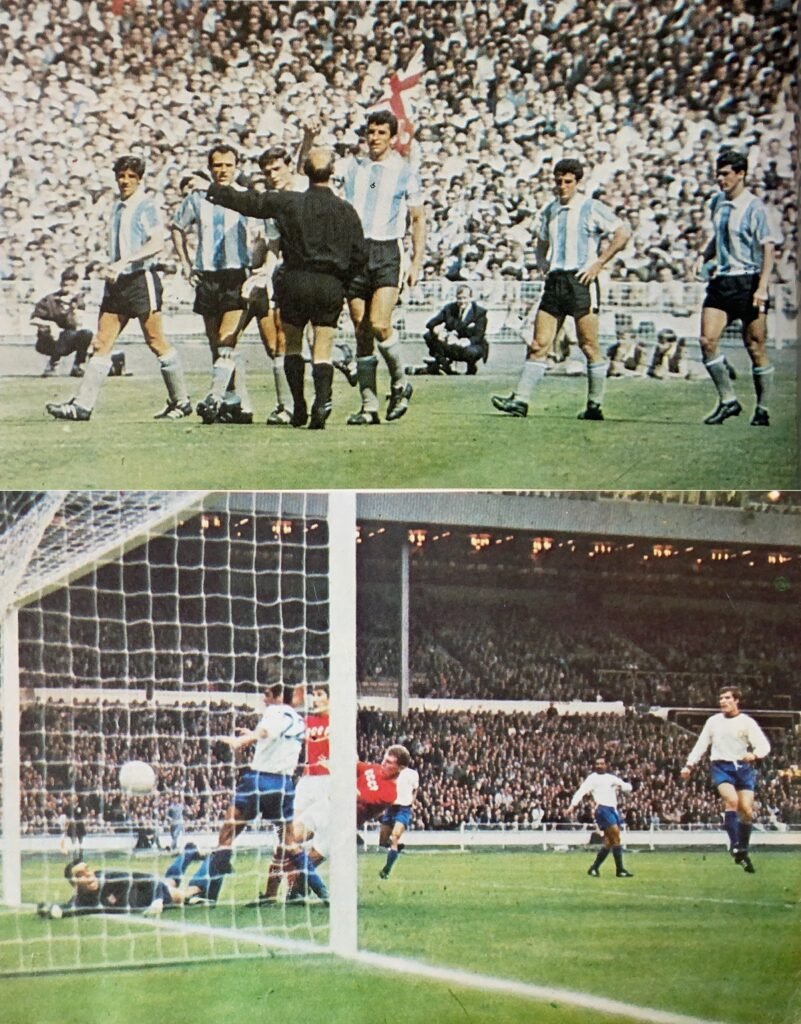
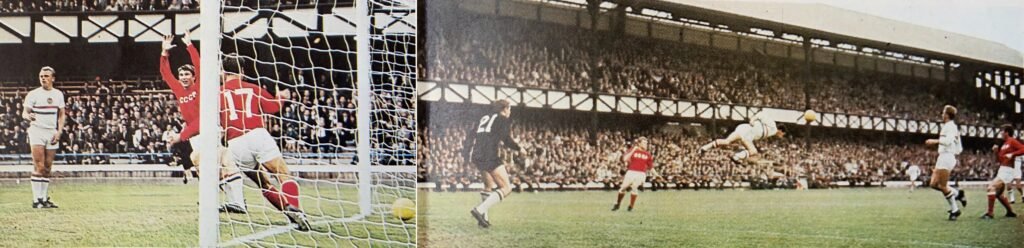
Antonio Rattín is sent off v England (above); Eduard Malofeyev scores for the USSR v Portugal (below)
The USSR beat Hungary, the last time the once-mighty Magyars reached the knock-out stages. Meanwhile North Korea’s adventure continued at Goodison Park, where their quarter-final with fellow debutants Portugal was a nine-goal thriller with the Koreans leading three-nil before a stunning Portuguese comeback. The outsiders returned home to an uncertain fate. The man who did most of the damage with four goals, Eusébio went on to score the first goal England conceded, a semi-final penalty, becoming top scorer of the 1966 finals with an impressive total of nine. Yet it was his only World Cup, and Portugal didn’t return until 1986.
Eusébio’s penalty was only a consolation as Bobby Charlton’s double helped England complete their fourth successive Wembley win, the tie having been controversially moved from Goodison where it was originally scheduled. West Germany awaited, after beating the USSR the previous day, with another first-half dismissal benefitting the German cause in front of less than 40,000. Eusébio netted once again from the spot as a late winner earned Portugal third place over the USSR, this game well attended at Wembley on the Thursday before Saturday’s final.
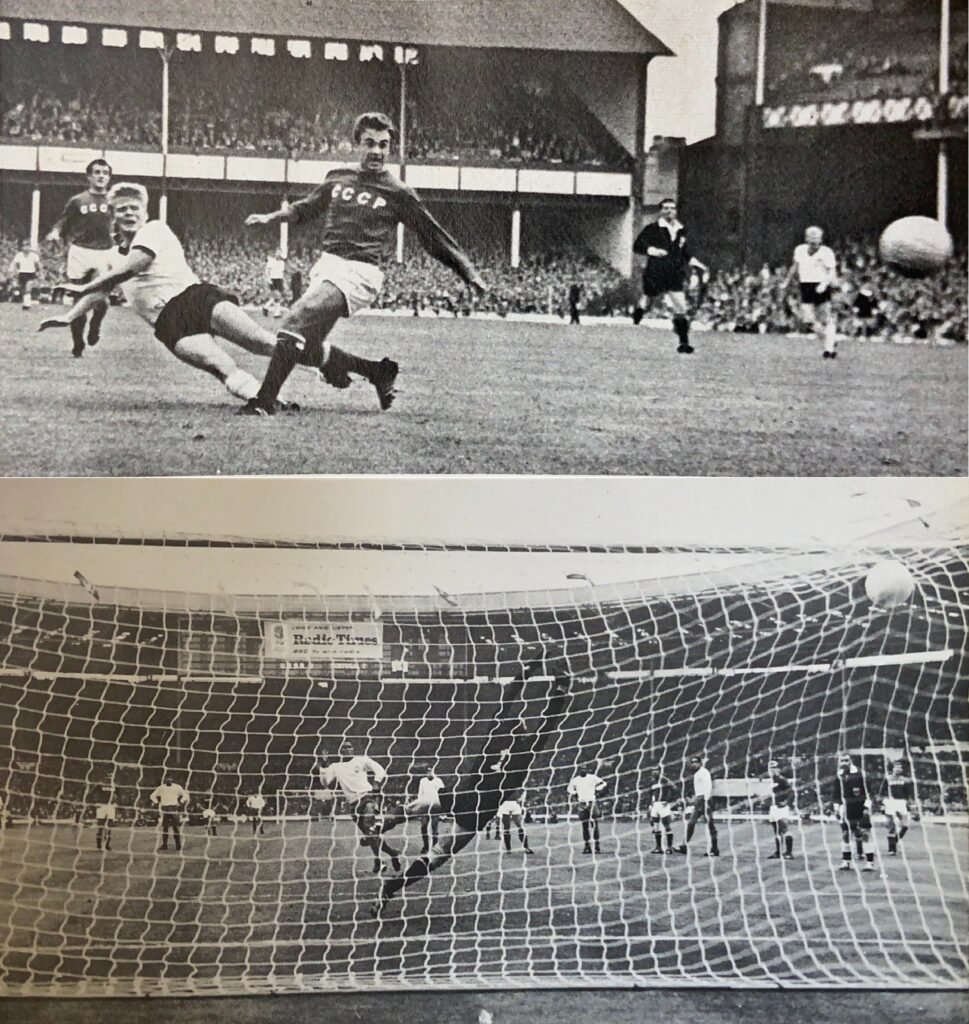
West Germany’s Helmut Haller scores against the USSR (above); top scorer Eusébio with his ninth goal of the 1966 finals (below)
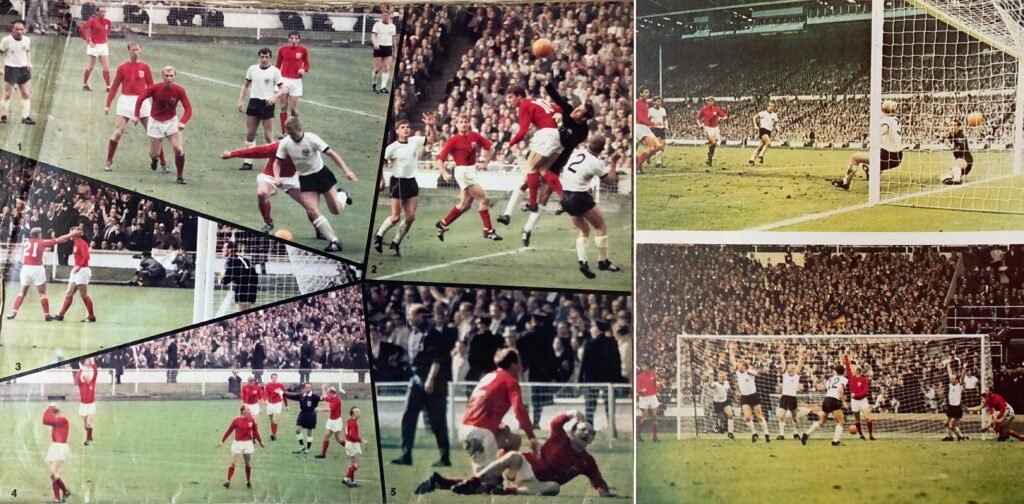
The final, broadcast in black-and-white from Wembley Stadium (colour arrived in dazzling satellite images for Mexico 1970) was watched by the UK’s highest-ever television audience – 32.3 million, over half the population in 1966. England, in red shirts for the only time in the tournament, became the first host nation to triumph since Italy in 1934. The ‘Russian’ linesman Tofiq Bakhramov, an Azerbaijani, is now commemorated in the naming of the national stadium in Baku (where his statue also stands). The BBC commentator Kenneth Wolstenholme gained a place in history with his famous “they think it’s all over… it is now” line as Geoff Hurst completed his hat-trick, the first in a World Cup Final (and only matched in 2022). Over on ITV, Hugh Johns was the ‘forgotten man’, with the words:
“Here’s Hurst, he might make it three. He has! He has… so that’s it. That is IT!”
Had the final finished level after 120 minutes, a replay would have taken place at Wembley on the evening of Tuesday, 2 August – and had that been drawn, a lottery would have decided the outcome. As it was, Bobby Moore lifted the Jules Rimet Trophy – but was it the real thing or a replica? After the pre-tournament theft and recovery by Pickles the dog, the FA commissioned a replica which was swapped with the original in the dressing room by a young policeman called Peter Weston. Awarded permanently to Brazil after their 1970 triumph, the Jules Rimet Trophy was stolen in Rio de Janeiro in December 1983, never to be recovered. Meanwhile the replica trophy retained by the FA was later bought by FIFA at a 1997 auction for £254,500.
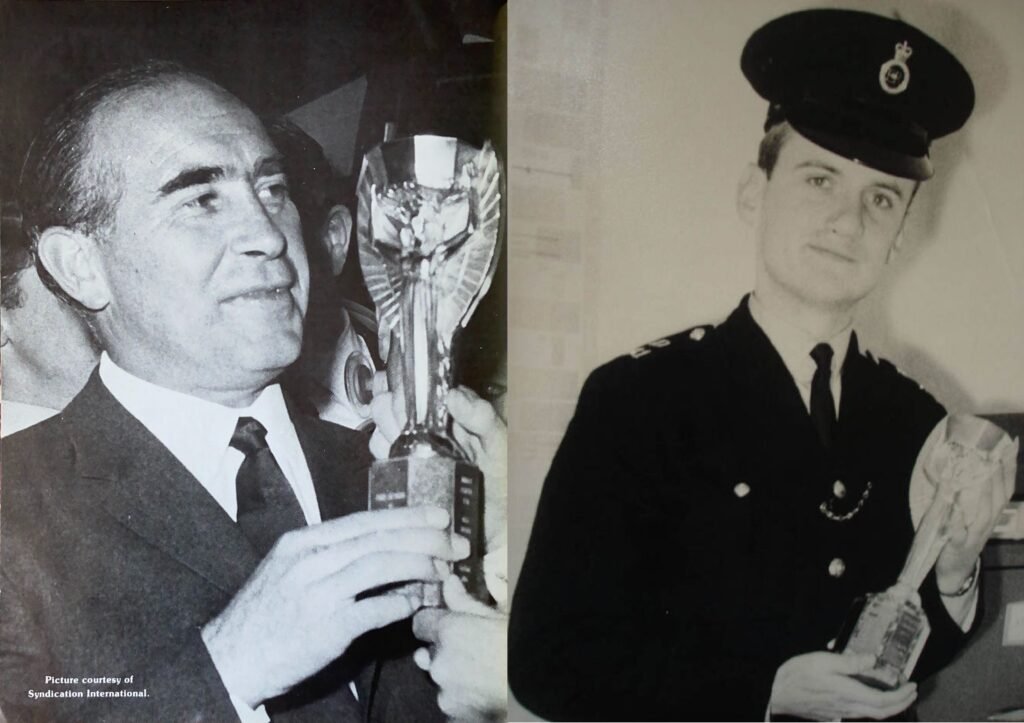
Alf Ramsey & Peter Weston with the Jules Rimet Trophy (original or replica)
At the insistence of captain Moore and his victorious team-mates, their £22,000 bonus for winning the 1966 finals was split equally between the entire squad, regardless of playing time. The players enjoyed a post-match banquet at the Royal Garden Hotel in Kensington (where the draw for the tournament had also been made) before a reception hosted by the FA and Prime Minister Harold Wilson. The players’ wives however were not admitted and ate a separate dinner at the hotel.
The winning players did enjoy some of the trappings of success, as Bobby Moore’s wife Tina recalls: “After the World Cup, people wanted to take photos of us, and we had offers coming in from every direction. We got a telegram from the composer Lionel Bart, inviting us to a party with Tom Jones and Joan Collins. Bobby got a contract modelling for Hornes Brothers, a men’s outfitters”.
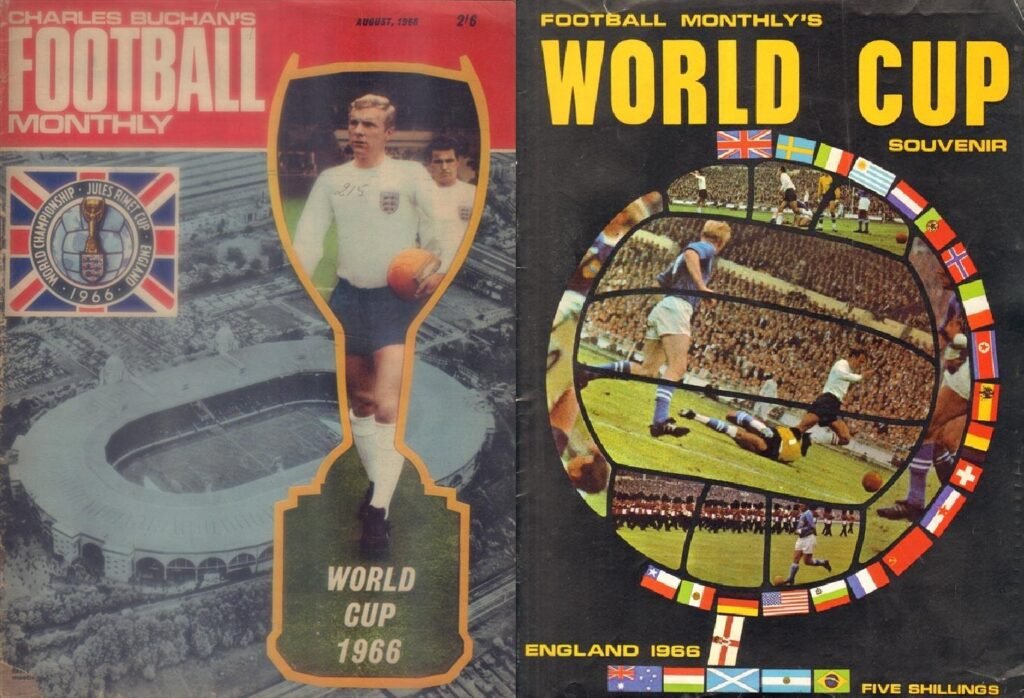
While Ramsey was knighted in January 1967, he, Cocker, Shepherdson and the non-playing squad members were only recognised with medals in 2009 when FIFA decided to make retrospective awards for all previous tournaments. Moore received an OBE at the time of Ramsey’s knighthood, followed by Banks and Jack Charlton, with Bobby Charlton and Hurst later knighted. It took until January 2000 for Alan Ball, George Cohen, Roger Hunt, Nobby Stiles and Ray Wilson to receive MBEs.
In attendance at Wembley for the final were Muhammad Ali, George Best, Bill Oddie and Eric Idle. Ali had fought Henry Cooper at Highbury earlier in the year and was back in London for another world title bout with Brian London at Earls Court in August. Bill Oddie was apparently given his ticket by John Cleese, to sit with his Monty Python colleague Idle. For the majority of the 100,000 capacity crowd, tickets could be bought for 10 shillings, approximately 50p and the equivalent of £8.37 as of May 2026!
USSR v Hungary quarter-final, Roker Park; North Korea celebrate their win v Italy; a West German supporter joins the celebrations v Uruguay
The 1966 finals were also influenced by the world political situation of the day. Even before the tournament, African nations boycotted en masse in protest at being denied an automatic qualification spot (they would have to navigate an inter-continental play-off). The ongoing ‘Cold War’ also had an impact. Mainly due to the delicate relations with North Korea – which the UK did not officially recognise at the time – on Foreign Office advice, national anthems were only played before the opening match and again before the final. Every nation had its flag displayed outside each of the host stadiums – at a cost of £1,000 to the Department of Education and Science – and the Foreign Office was also keen for North Korea’s to be removed.
Only a handful of players from France, Spain and West Germany were based outside the country they represented (and those mainly played in Italy); every one of the other 13 nations took an entirely domestically based squad to the 1966 finals. Similarly, only three nations had a manager or coach from another country, with a Czechoslovak taking charge of Bulgaria, an Italian leading Switzerland and Brazilian Otto Glória having made his name at Benfica, coaching Portugal.
Garrincha scores in Brazil’s opening game v Bulgaria
Notable milestones included Pelé and Uwe Seeler each scoring in their third World Cup – and both were to continue at Mexico 1970. The 37-year-old Mexican goalkeeper Antonio Carbajal also set a new record by appearing in his fifth finals tournament, keeping a clean sheet in a goalless group draw with Uruguay. Attendances reached a new high, with the average of 48,848 marginally above Brazil 1950. The 1966 finals produced an average of 2.78 goals per game – equal to Chile 1962, regarded as the grimmest finals to date, and eclipsed by Mexico the next time around in terms of goals, crowds, entertainment and spectacle.
England’s 1966 World Cup-winning team lined up against a West Germany side with seven Wembley starters in sad circumstances, re-creating the final 19 years later at Elland Road. In a fund-raiser for the Bradford fire disaster at the end of July 1985, Geoff Hurst scored another hat-trick in an entertaining 6-4 win for England.
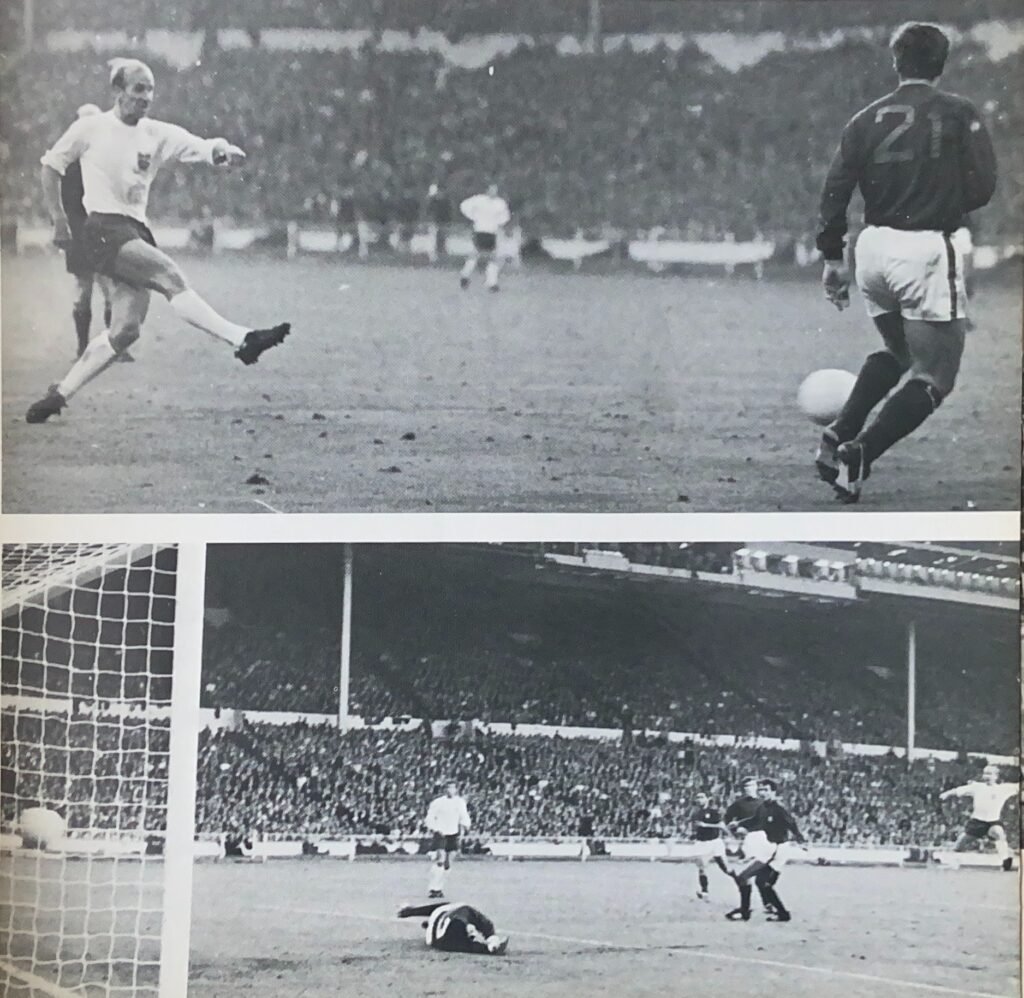
Bobby Charlton scores in the 1966 World Cup semi-final v Portugal